Meat, eggs and dairy in Germany: which label, which shop, what life
Pick a product to narrow the whole page. See what the animal's life looks like behind each shop's line, which label wins, where to buy in Frankfurt-Bornheim, and where the evidence runs out.
Life in photos
Pick a product and a shop line to see that animal's life, stage by stage. Each photo is tagged with whose farm it shows. "No photo found" means no sourced photo exists for that stage; it is never filled with another level, species or brand.
What to grab
Shopping summaries from the earlier reports
Meat, milk and eggs
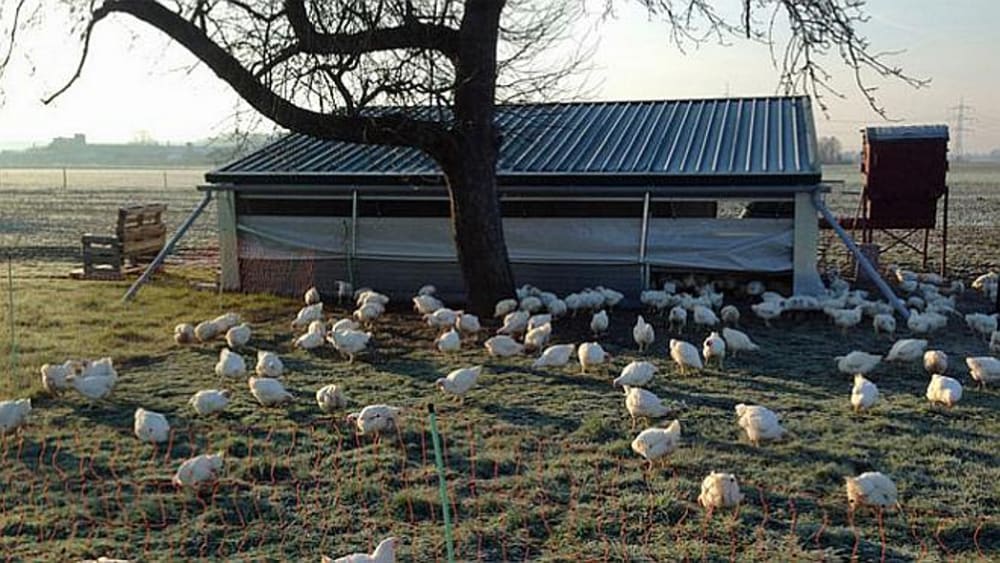
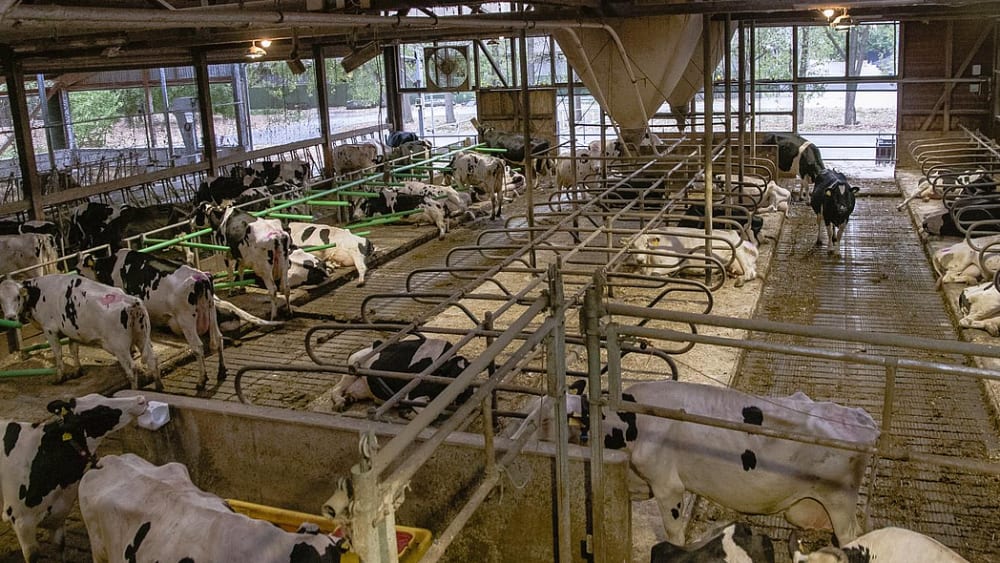
The big jump is between 2 and 3, and again at 4. Levels 1 and 2 are both closed barns; 2 adds only modest space (pigs 12.5% more, broilers 35 instead of 39 kg/m²). Level 3 brings outdoor air, and for chicken also a slow-growing breed and 25 kg/m². Level 4 is the first level where the animal actually goes outside (or, for dairy, grazes).
Level 5 is simply certified organic, so the EU organic or Bio association logo on the same pack says the same thing.
For eggs, read the first digit on the shell: 0 or 1 means outdoor access, 2 means barn only.
For lamb and goat, only Bio tells you anything about housing.
Dairy and local
Milk: any HF3 or HF4 milk excludes tethering on paper. If you buy Bio, prefer a dairy that has stated no tethering: in Öko-Test 2021 that was dennree (at denn's), Upländer Bauernmolkerei, Schwarzwaldmilch and Gläserne Molkerei. Biopark bans tethering outright for every farm; Biokreis does so for farms that joined from March 2024.
Yoghurt and quark: fewer products carry a level. Bio is the safer signal; Öko-Test 2024 rated Netto BioBio and Kaufland K-Bio natural yoghurt "sehr gut".
Cheese: German cheese at Edeka is half HF3+. For imported cheese only the Bio logo means anything, and PDO cheese tells you nothing about the cows. At a counter, ask "Bio? Aus welchem Land? Tierisches oder mikrobielles Lab?"
In Frankfurt-Bornheim: the closest place with a stated sourcing chain is denn's on Berger Str. 155. The Erzeugermarkt Konstablerwache is where you can buy cheese and meat from a named farm. For the butchers and the Käseladen, ask them directly where the animals and the milk come from.
Supermarket chooser
Gauge: the best line at each chain. Dark tiles: products listed for its top lines; dashed: not listed. Black dots: independent looks at its suppliers (open for the list); a dashed ring: none found. Thick green border: an association line across meat, eggs and milk, or eggs all from rooster-rearing farms.
Names checked and dropped: Wilhelm Brandenburg (Rewe's meat company, no HF4/5 line found), Aldi "Fair & Gut", Edeka "Gutfleisch" and "Hofkost", Rewe "Respektiert" and "Bruderherz". Corrections: Spitz & Bube is Rewe, Hofglück is Edeka Südwest, #Haltungswechsel is Aldi's campaign, Nur Nur Natur is Naturland. Retailer targets: Rewe, Aldi and Penny aim for 100% of own-brand fresh meat at HF3 or higher by 2030 (Penny says HF3 and 4); Aldi Süd reports 60% of own-brand fresh meat and 100% of drinking milk at HF3 to 5.
What the big chains have said. Aldi Süd says its own-brand fresh meat has had no level 1 since the start of 2026, 100% of its own-brand drinking milk has been level 3 to 5 since February 2024, and it aims for levels 3 to 5 only for fresh meat by 2030; its BIO and Nur Nur Natur brands are level 5. Lebensmittel Praxis reported in October 2025 that Rewe and Penny were moving their own brands to at least level 2 by mid-January 2026, that Aldi Nord, Kaufland, Edeka and Netto had already done so for pork and poultry (with some beef still at level 1), and that all the large chains aim for level 3 and up on own-brand fresh meat by 2030. These are the retailers' own commitments and apply to own brands; I did not find a source listing level by individual product line.
Meat and egg lines per retailer, full table
Organic meat and milk is Haltungsform 5; organic eggs are code 0. Packs printed before July 2024 used four levels, where Bio was "4 Premium". Levels come from retailer pages, press releases and trade press; haltungsform.de has no product search.
| Retailer | Brand or line | Association | Products and level |
|---|---|---|---|
| Rewe | REWE Bio | Naturland | all REWE Bio meat, almost all sausage, many dairy products (HF5) |
| REWE Bio eggs, Spitz & Bube | about 60% Naturland farms, rest other associations | code 0, brother roosters reared; pilot with dual-purpose hens (Eichberghof, Naturland, Baden-Württemberg and Pfalz) | |
| Premium Landbauern | none | HF4, e.g. veal; service counter in some regions (plain Landbauern is HF3) | |
| Bioland at Rewe (since January 2026) | Bioland | fruit, vegetables, milk and dairy; no meat or eggs named | |
| Edeka | EDEKA Bio | Bioland, Naturland, Demeter | over 100 Bioland products incl. milk; Bioland beef burgers (HF5) |
| Natur Pur (EDEKA Nord) | Biopark | beef, veal, pork, lamb, chicken, HF5 | |
| Hofglück (EDEKA Südwest) | none; Tierschutzbund Premium label | pork and poultry, about 50 regional farms; described as level 4 by Lebensmittel Praxis | |
| Netto Marken-Discount | BioBio | Naturland, Biokreis | e.g. Biokreis pork steaks; own-brand organic eggs without chick killing (rooster rearing or in-ovo sexing) |
| Aldi Nord | GUT BIO | Naturland (since 2023) | started with organic milk; aldi-nord.de could not be read for more |
| Aldi Süd | NUR NUR NATUR | Naturland | milk, yoghurt, cheese, sausages, Landhähnchen; HF5. Farm pages for about 15 Naturland suppliers via QR traceability |
| BIO | EU-Bio, some Naturland | all meat and milk HF5; own-brand eggs without chick killing since 2021 | |
| Lidl | Bioland (since 2018) | Bioland | about 100 products: milk, dairy, Bioland eggs, Bioland meat (HF5); German organic eggs with rooster rearing since 2021 |
| Kaufland | K-Bio | Bioland, Demeter; Naturland from 2027 | 17 Bioland meat items (mince, goulash), over 150 Bioland items incl. milk (HF5). K-Wertschätze is only HF3 |
| Penny | NATURGUT | EU-Bio; some items Naturland | over 750 organic products; which animal products are Naturland is not stated |
| Alnatura | Alnatura eggs, Alnatura Origin | mostly Bioland, Biopark, Demeter, Naturland; Origin from Brodowin (Demeter) and two Bioland farms | code 0, all with brother roosters; Origin from mobile barns. Weidemilch: pasture at least 120 days of 6 hours |
| denn's (biomarkt.de) | Königshofer; Hofgut Eichigt; haehnlein | Hofgut Eichigt: Bioland and Biokreis | organic meat, sausage, eggs (all with roosters reared); milk from horned cows on pasture, calves with mothers |
| Rossmann | enerBiO | moving to Bioland "where possible" (2020) | no meat or egg line found |
| dm, Netto (Stavenhagen) | no top-level meat, milk or egg line found | ||
Dairy lines per retailer, full table
Only lines a retailer, trade press or a test names. Where a cell says "not confirmed" I looked and did not find it stated. Product-level labels marked OFF were read from Open Food Facts, a crowd-sourced database of pack photos, not from the retailer.
| Retailer | Milk | Cheese | Yoghurt | Tethering or pasture statement |
|---|---|---|---|---|
| Rewe | REWE Bio frische Weidemilch, Naturland, HF4 (OFF). Bioland milk and dairy announced January 2026, no products named | REWE Bio; association not confirmed | REWE Bio; association not confirmed | none found |
| Edeka | EDEKA Bio Bioland milk (over 100 Bioland items incl. milk and yoghurts) | EDEKA Bio; association per product not confirmed; 50% of own-brand block/sliced cheese HF3+ | EDEKA Bio Bioland yoghurts | dropping HF1 milk in 2022 meant "keine ganzjährige Anbindehaltung mehr" for Edeka, Edeka Bio, Gut&Günstig, BioBio, Gutes Land |
| Aldi Nord | GUT BIO, Naturland since 2023 (started with milk) | not confirmed | not confirmed | drinking milk HF3/4 only, "der neue Mindeststandard" |
| Aldi Süd | NUR NUR NATUR Bio-Vollmilch, over 90% Naturland line | NUR NUR NATUR (Naturland per earlier report) | NUR NUR NATUR (Naturland per earlier report) | own-brand drinking milk 100% HF3 to 5 since Feb 2024 |
| Lidl | Bioland milk | Bioland mozzarella and Landkäse | Bioland natural and fruit yoghurt; Bioland quark | "Bioland-Rinder sind so oft es geht auf der Weide oder haben ganzjährigen Auslauf" |
| Kaufland | K-Bio frische Vollmilch, Bioland, HF4 (OFF) | K-Bio; association not confirmed | K-Bio Joghurt mild ("sehr gut" in Öko-Test 2024); association not confirmed | none found |
| Netto | BioBio; Naturland partnership since July 2023, dairy not named | not confirmed | BioBio Cremiger Bio Joghurt mild ("sehr gut", Öko-Test 2024) | covered by Edeka's 2022 statement |
| Penny | Naturgut frische Bio Weidemilch, EU-Bio, HF4 (OFF), no association | Naturgut, EU-Bio | Naturgut, EU-Bio | none found |
| Alnatura | Alnatura Bio-Weidemilch: whole dairy base range from about 820 farms, 120 days of 6 h, at least 1,000 m² pasture per cow | Alnatura Parmigiano Reggiano the only "gut" in Öko-Test 2019 | Alnatura Weidemilch range (milk, yoghurt, crème fraîche, butter) | no tethering statement found; milk rated "sehr gut" overall in Öko-Test 2021, but Alnatura is not among the 4 brands Öko-Test names as having proved no tethering |
| denn's | dennree (no "denn's Bio" brand yet, Lebensmittel Zeitung, Aug 2026); part of the milk from dennree's own Hofgut Eichigt (about 1,300 cows, calves with mother or nurse cow since 2019) | dennree | dennree | dennree is one of the 4 brands that proved no tethering in Öko-Test 2021 |
Local in Frankfurt-Bornheim
Butchers, cheese shops, organic shops and markets in and around Bornheim, a district of Frankfurt am Main. Green border: names its farms. Dashed: does not state its sourcing. No food inspection results or press checks were found for any of these shops.
No meat, egg or milk farm shop is listed in OpenStreetMap for Seckbach or Bergen-Enkheim; MainÄppelHaus Lohrberg (Seckbach) sells only fruit from its own trees. Basic Bio on Berger Str. 40 turned up only in an old search snippet and is probably closed, so it is left out. No local shop was found that states where its eggs, lamb or goat come from. At a counter, ask: "Bio? Aus welchem Land? Tierisches oder mikrobielles Lab?"
Label ladder
Every level is a minimum, not an average. Shapes are drawn to scale against each other: the green square is floor per kilogram of chicken, the bar is space per fattening pig (hatched part outside).
Eggs use their own scale
Squares to scale: dark is space inside per hen, green is the outdoor area per hen around it.
How many hens share one building
How many hens are actually out in the run
German laying hens by system, 2024
German pigs by level
Organic milk: who proved no tethered cows
Is the cow ever tied up?
Year-round tethering (Anbindehaltung) and seasonal tethering (Kombihaltung: tied in the barn in winter, pasture in summer). Thünen 2020: 11% of German dairy cows were tethered, 8% year-round. No German law bans either yet; Region Hannover ordered its own phase-out on 7 July 2026.
Only Haltungsform 3 and 4, Biopark, and Biokreis for newer farms rule out both forms on paper. Every other Bio label can contain milk from small farms that tie cows in winter.
Where the associations differ from each other
Biokreis (on Netto BioBio and Hofgut Eichigt at denn's) is an association too; its meat and egg rules were not compared.
Minimum vs best
Short answer: these are minimums
Every number in the earlier report (Haltungsform levels, egg codes 0 and 1, EU-Bio) is a floor, not an average and not the best. The texts say so themselves:
- EU egg marketing rules, Reg. (EU) 2023/2465, Annex II is titled "Minimum requirements for systems of production", and free-range eggs must come from systems that "satisfy at least" the listed conditions (one hen per 4 m² outdoors, at most 2,500 hens per hectare, run within 150 m of a pophole, or 350 m with four shelters per hectare). Art. 11(3) lets a country set measures "going beyond the minimum requirements".
- German law (§ 13a TierSchNutztV) is phrased the same way: at least 1 m² usable area per 9 hens, no more than 6,000 hens without separation.
- EU-Bio (Reg. 2018/848 Annex II, Implementing Reg. 2020/464 Annex I) speaks of "the minimum surface for indoor and outdoor areas". Art. 33(5) allows private logos on products "which comply with this Regulation", so an association label sits on top of full EU compliance.
- Bioland and Demeter write it into their own rules: farms must meet the EU organic regulation, and "unberührt davon sind weitergehende und ergänzende Bestimmungen" of the association.
Egg code 0 cannot tell you which kind of Bio. An egg from an EU-minimum organic farm and one from a Demeter farm both carry 0. Only the association logo on the pack tells them apart.
EU-Bio and the associations, rule by rule
From each association's own current Richtlinien (Bioland and Gäa March 2026, Naturland 05/2026, Demeter Gesamt-Richtlinie 2026, Biopark January 2022, the newest on its site). Gäa's text matches Bioland's in every value checked, so they share a column. "= EU" means the association states the same value. A dash means no rule was found in that document.
Laying hens
| EU-Bio (minimum) | Bioland / Gäa | Naturland | Demeter | Biopark | |
|---|---|---|---|---|---|
| Hens per m² inside | 6 | 6, and max 4.8 averaged over the whole house | 6; 4.8 incl. winter garden in multi-tier | 6 | 6 |
| Covered veranda | no fixed ratio | 1 m² per 12 hens | at least 1/3 of floor (1/2 in aviaries), farms over 200 hens | 1 m² per 18 hens | - |
| Outdoor per hen | 4 m² | 4 m², within 150 m | 4 m², within 150 m | 4 m², within 150 m | 4.2 m², max 300 m walk |
| Flock / house size | 3,000 per compartment, no limit per building | 3,000 per barn, 6,000 per building | 3,000 per barn, 12,000 per building | 3,000 per building, 150 m to the next | 3,000 per compartment, 6,000 per building |
| Hens per farm | no head cap (170 kg nitrogen per ha) | 140 per ha | 140 per ha | 140 per ha | 140 per ha |
| Beak trimming | exceptionally allowed in first 3 days | banned | banned | banned | banned |
| Male chicks | no rule found | killing banned, one cockerel reared per hen | killing banned, one cockerel reared organically per hen | one Bruderhahn per hen, slaughtered at 14 weeks or older; in-ovo sexing banned | - |
| Roosters in flock | - | 1 per 100 "where possible" | - | 1 per 50, mandatory | 1 per 100, mandatory |
Broiler chicken
| EU-Bio | Bioland / Gäa | Naturland | Demeter | Biopark | |
|---|---|---|---|---|---|
| Density, fixed barn | 21 kg/m² | 21 | 21 | 16; 21 (max 10 birds/m²) with veranda | 21, 10 birds/m² |
| Birds per house | 4,800 per compartment | 4,800 per flock, 9,600 per building | 4,800 | 3,000 per building | 4,800 |
| Minimum slaughter age (fast-growing breeds) | 81 days | 81 | 81 (slow breeds preferred) | - | 81 |
| Outdoor per bird | 4 m² (2.5 mobile) | 2.5 m² within 150 m plus 1.5 m² within 350 m | = EU | = EU, max 80 m from house | = EU |
| Birds per ha | 170 kg N/ha | 280 | 280 | 280 | 580 |
Pig
| EU-Bio | Bioland / Gäa | Naturland | Demeter | Biopark | |
|---|---|---|---|---|---|
| Space, fattening pig | up to 110 kg: 1.3 m² in + 1.0 out; over 110 kg: 1.5 + 1.2 | = EU | = EU | = EU | = EU (over 110 kg row) |
| Outdoor run floor | - | at least 50% solid | at least 50% solid | - | at least 50% solid, no full slats |
| Pigs per ha | 170 kg N/ha | 10 fattening pigs or 6.5 sows | - | 10 or 6.5 | 14 or 6.5 |
| Tail docking | not among allowed exceptions | banned | banned | banned unless a vet indicates it | banned |
| Castration | with anaesthesia and/or pain relief | only with anaesthesia and pain relief | surgical only with anaesthesia and pain relief | without anaesthesia banned; immunocastration banned too | with anaesthesia or pain relief |
| Sows | group housing except late pregnancy and suckling | no tethering; crates only for problem sows | no tethering; short fixing for problem sows | - | no tethering; fixing max 14 days at farrowing |
Cattle and feed
| EU-Bio | Bioland / Gäa | Naturland | Demeter | Biopark | |
|---|---|---|---|---|---|
| Tethering | allowed on farms of up to 50 animals with pasture, or outdoors twice a week | year-round tethering excluded; combined housing for small herds | not allowed; combined housing only up to 35 livestock units | - | not allowed |
| Pasture | whenever conditions allow | mandatory (older farms until end 2030) | mandatory in growing season | mandatory, at least 600 m² per livestock unit | at least the summer half-year |
| Dehorning | exceptionally, case by case | only with approval and anaesthesia | not recommended; caustic sticks banned | banned; dehorned and genetically polled animals not allowed | only if unavoidable, with pain relief |
| Calf with mother | - | at least 1 day | recommended for the first days | - | - |
| Feed from own farm or region, cattle | 70% | 70% | 70% | 70%, and 70% Demeter quality | 70% |
| Same, pigs and poultry | 30% | 50% | 50% | 50%, 70% Demeter quality, 100% organic | 50% |
Where associations most clearly beat the minimum: beak trimming and tail docking banned everywhere; male chicks reared (Demeter, Bioland, Naturland, Gäa); smaller buildings for hens (Demeter 3,000, Bioland and Biopark 6,000 versus no EU cap per building); a hard cap of 140 hens or 280 broilers per hectare; Demeter's lower broiler density and its ban on dehorning. Where they match EU-Bio: indoor hen density, pig space, outdoor area per hen.
What real farms look like versus the minimum
- Flock sizes. BLE egg report 2025 (Destatis data, farms with over 3,000 places, 2024): 832 free-range farms with 10.7 million hens, 619 organic farms with 6.5 million. That works out to about 12,900 hens per free-range farm and 10,500 per organic farm on average (my division, not a BLE figure). Mobile barns hold about 50 to 2,500 hens and are not counted separately. The Thünen-Institut (2018, 2017 data) put the average German laying-hen farm across all systems at 23,000 hens, 67,000 in Brandenburg.
- Large Bio units are normal. Gerold Rahmann, then head of the Thünen institute for organic farming, told ZDF Frontal 21 in 2013: "Bislang sind Massenställe von bis zu 15 000 Tieren in 3000er-Einheiten üblich."
- How many hens actually go outside. In a 2003 Lower Saxony study of organic flocks, on average 9.8% of a 4,500-hen flock were in the run, most within 17 m of the barn, against 40% in a 1,450-hen flock. A literature review (LMU München dissertation, 2005) cites 37.9% outside in a flock of 250, 22.7% in a flock of 1,000. I found no current national figure from FLI or Thünen.
- Pigs. The pig farmers' association ISN (February 2025): levels 3 and 4 together about 2% of German pigs, organic (level 5) about 1%.
- Tethered cows. Thünen-Institut (2020 census): 35% of dairy farms and 11% of cows tethered, 8% of cows year-round; organic farms are affected "in a much smaller extent", without a number in the page text. Öko-Test (2021, 20 organic milks incl. the organic lines of Aldi, Lidl, Rewe, Edeka, Kaufland, Netto, Penny): only 4 providers proved no milk came from tethered cows, only 8 proved pasture for every farm. Öko-Test (2024, 20 organic yoghurts): 11 brands had at least some suppliers who tie cows part of the year.
- Organic calves. dpa (2021): of calves from about 180,000 organic dairy cows, "vielleicht 25 Prozent" stay for breeding and 75% go mostly into conventional fattening.
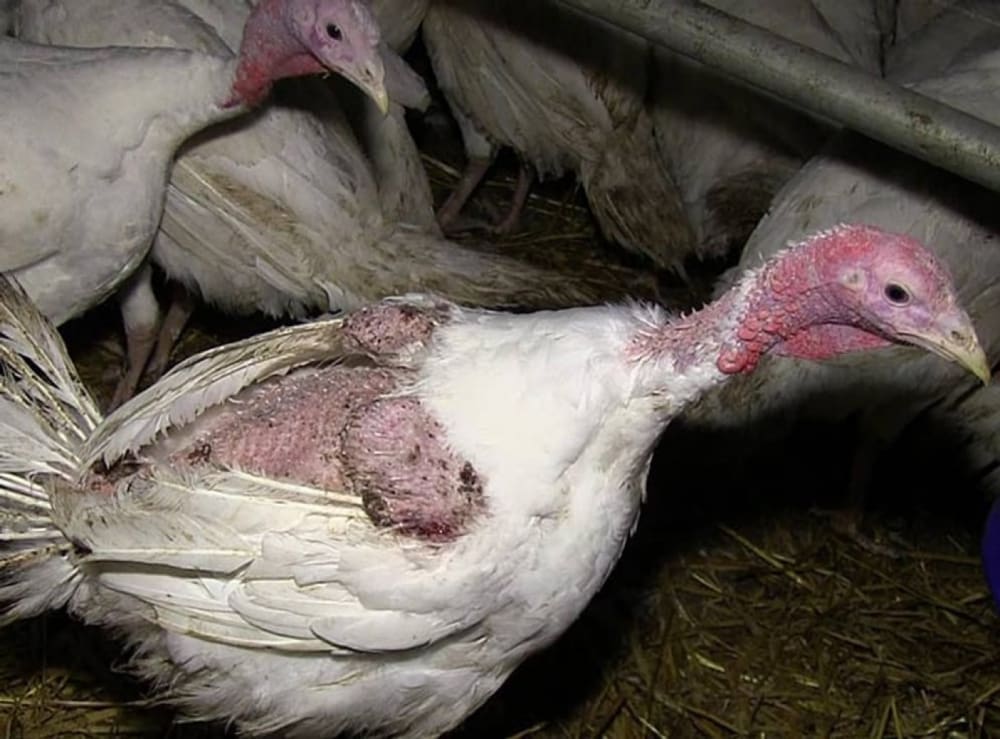
- Health is not much better. foodwatch (2023, from veterinary studies): about 35% of organic pigs versus nearly 40% of conventional pigs had serious health findings. A Uni Leipzig study of over 300,000 organic and 250,000 conventional turkeys found "grundsätzlich die gleichen Gesundheitsprobleme" (Weser-Kurier, 2013).
- How often farms are checked. BÖLW: organic farms are inspected 1.3 times a year on average (Die Zeit 2021, via top agrar). In Bavaria every organic business is checked yearly and 20% a second time by risk (Agrarbericht 2024). Control bodies are paid by the farms they check, a point a LAVES Niedersachsen official made to Die Zeit. For Initiative Tierwohl (level 2) the main audit is announced up to 48 hours ahead, plus one unannounced check a year since 2017. I found no published audit statistics for Haltungsform.de itself.
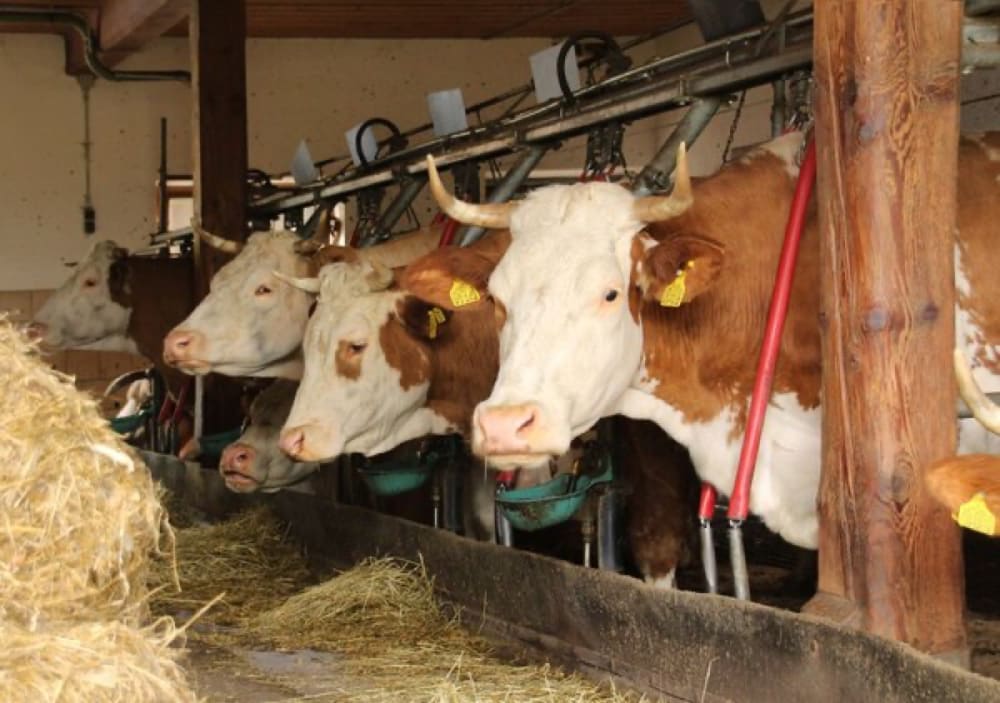
Investigations and tests
What unannounced checks found
Below are cases where someone outside the brand looked at farms supplying top-level labels: undercover recordings by animal rights groups (marked activist), broadcasters, authorities, courts and product tests. Activist recordings are usually made by entering barns at night without permission; the farm's and the authorities' answers are given each time, and several dispute the findings. These are individual cases, not a sample. Where a source gives a scale it is stated. Most cases are about Bio eggs, because that is where most investigations have been done. Images are the sources' own published stills; each credit links to the original.
Eggs (code 0 and 1)
Aldi Süd Bio eggs from Dutch farms (2017 and 2024)
- 2017
- SWR Marktcheck (13 June) and Deutsches Tierschutzbüro traced Aldi Süd Bio eggs by egg code to two Dutch farms: "etliche Kadaver und verbotene Elektroleitungen", no hen outside just before noon although access is required from 10 a.m., dead and partly decomposed hens. Aldi Süd said this did not meet KAT rules or its own binding requirements and stopped buying from both farms.
- 2024
- ANINOVA (formerly Deutsches Tierschutzbüro) with SWR, 23 July: a Dutch Bio farm supplying Aldi Süd, about 9,000 hens in three sections of up to 3,000; hatches to the run closed in the daytime, ponies and an electric fence on the run, feather pecking. The operator told SWR a bird flu warning kept the hens in.
- Scale
- two farms (2017), one farm (2024)
- Sources
- top agrar 2017, Mannheim24 2017, ANINOVA 2024

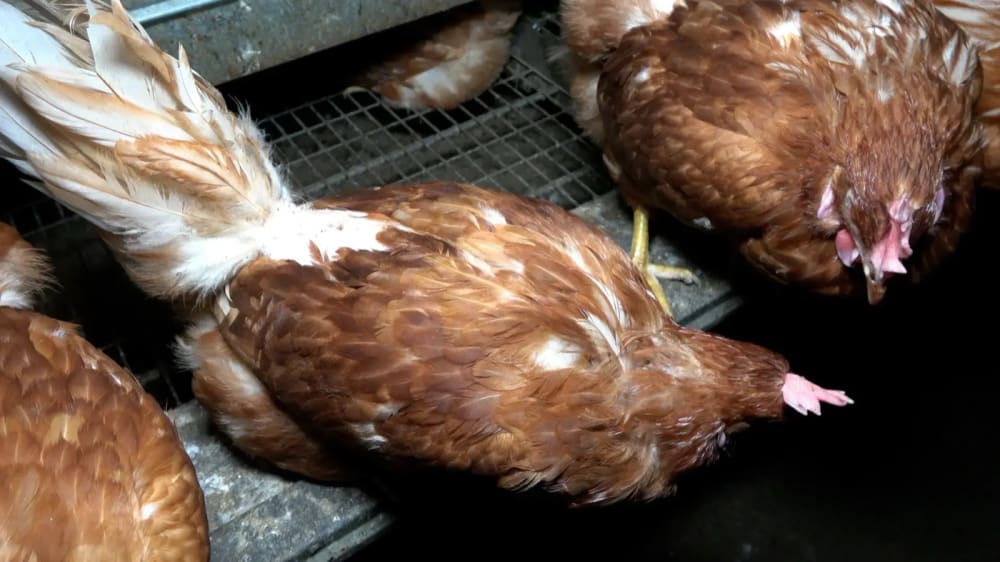


Bio hens producing for Kaufland and Aldi, Emsland (2023)
- Who
- ARIWA with NDR Markt, March 2023: "drei Bio-Hennen-Betrieben in Niedersachsen, die für Kaufland und Aldi produzieren", video from two farms in Landkreis Emsland. Farms not named.
- Found
- bald hens, purulent cloacas, dead hens; aviaries holding 12 hens per m² of barn floor (allowed under EU-Bio for multi-tier).
- Response
- none on ARIWA's page. ZDF "Food Fahnder" re-examined the Kaufland footage (8 January 2024); I did not read its findings.
- Note
- ARIWA does not state the filming date; the image files sit in a 2022 upload folder.
- Source
- ariwa.org


Landkost-Ei Bio eggs, Uckermark, sold at Kaufland (2019)
- Who
- ARIWA release, 22 October 2019: a Uckermark barn for up to 39,999 hens producing Bio eggs for the Landkost-Ei brand, sold among others at Kaufland.
- Found
- bald hens, purulent cloacas, dead hens among live ones.
- Source
- ARIWA release via yumda. No photos saved.
Bio farm in Lower Saxony supplying Edeka and Marktkauf (2019)
- Who
- Deutsches Tierschutzbüro (now ANINOVA), September 2019; the farm is named only as "niedersächsischer Bio-Betrieb".
- Found
- hens "übereinander gestapelt auf Gitterböden", dead hens left for days, some with maggots, injured birds untreated.
- Response
- Edeka and Marktkauf took the eggs out of sale (per ANINOVA). The criminal complaint was dropped by the prosecutor; an administrative offence procedure was opened.
- Source
- aninova.org


Geflügelhof Zeeb, Reutlingen: Freiland eggs at regional Edeka and Rewe (2025)
- Who
- ANINOVA, July 2025; farmer Frank Zeeb, about 12,000 hens; eggs sold in some regional stores, not nationwide.
- Found
- sick, injured and dead hens; electric fences ANINOVA says kept hens inside.
- Response
- Head of the Kreisveterinäramt: "Fehlinterpretation seitens Aninova"; the electric fence was illegal but meant for a young-hen area, removal ordered; other hens always had range access; part of the flock already looked poor at the April salmonella check. Rewe: KAT audit on 15 July, hens are free-range. Edeka: its own welfare staff found free-range rules met. The farmer called the fence a mistake. Staatsanwaltschaft Tübingen opened an investigation (per ANINOVA).
- Sources
- Schwäbische Zeitung, farmer's reply, ANINOVA
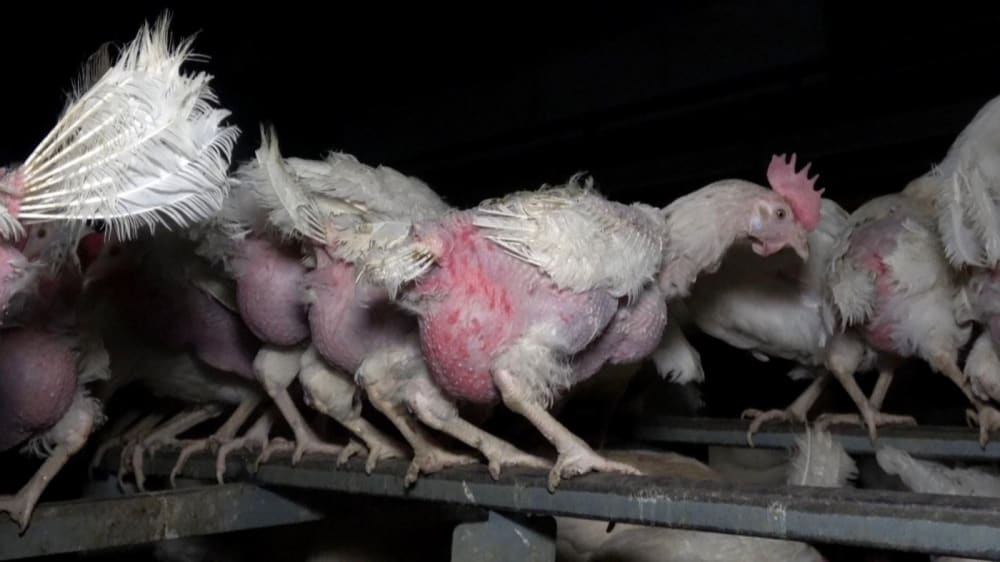
Naturland and Verbund Ökohöfe farms, Brandenburg and Mecklenburg-Vorpommern (2021)
- Who
- ARIWA with Die Zeit, filmed June 2021, published 18 November 2021. Farms as ARIWA names them: Bio-Geflügelhof Mühlenberg (Dranse) and BioHof Wildkuhler Kuhlen 2 GmbH (Bollewick), "von Naturland und dem Verbund Ökohöfe zertifiziert". Die Zeit describes a farm with 30,000 hens.
- Found
- bald hens, inflamed purulent cloacas, dead hens among live ones.
- Response
- Naturland: the hens showed "das normale Verhalten bei Nacht", the flock was being treated for a streptococcal infection, the photos were "nicht wirklich repräsentativ". Verbund Ökohöfe inspected and found the hens "in einem guten Zustand".
- Sources
- ARIWA release, top agrar on Die Zeit
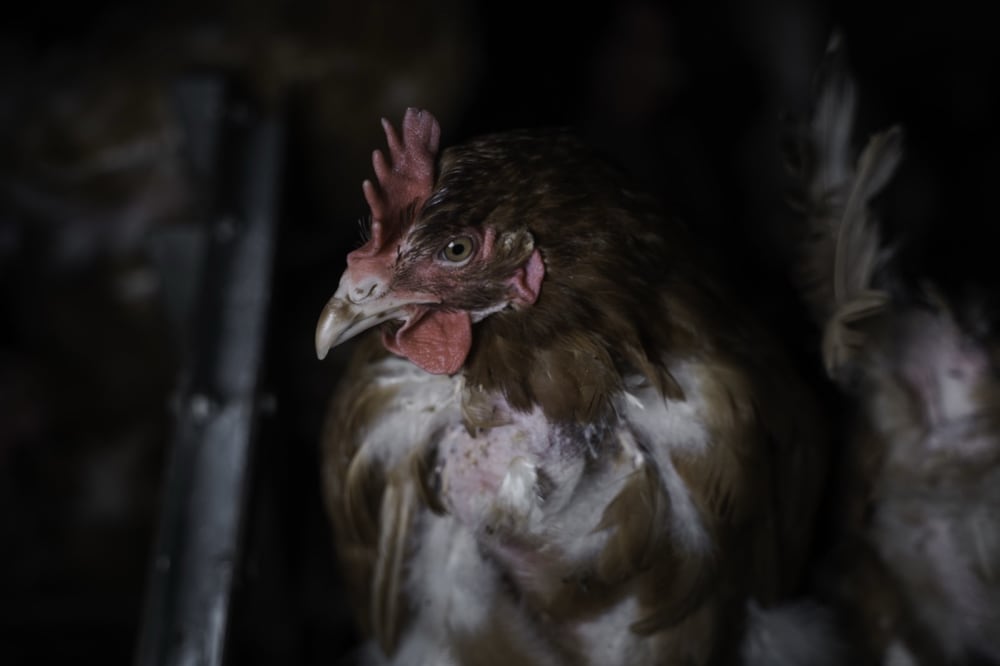
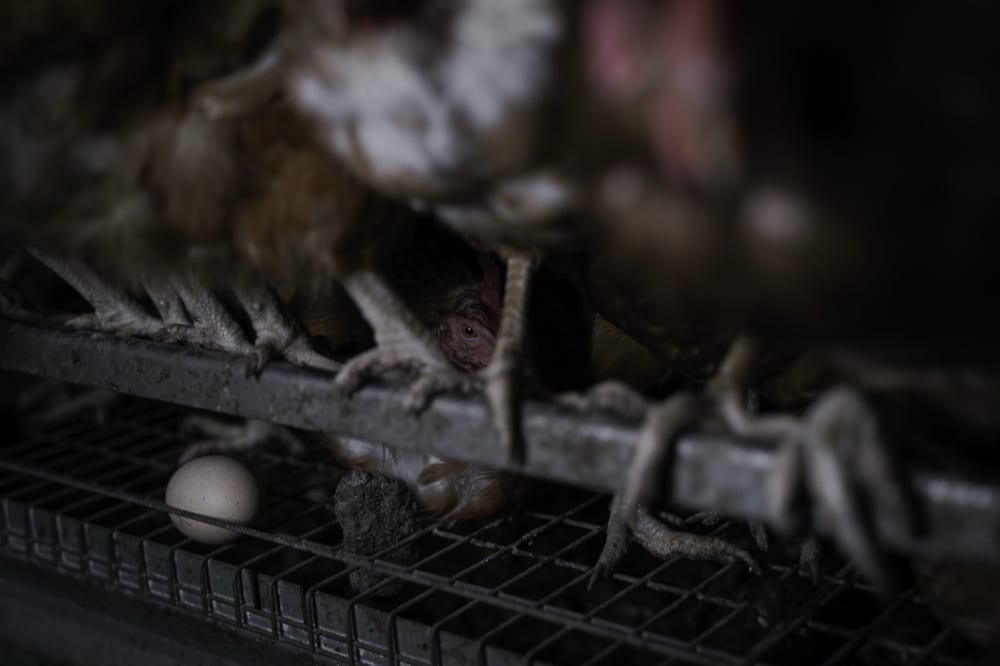
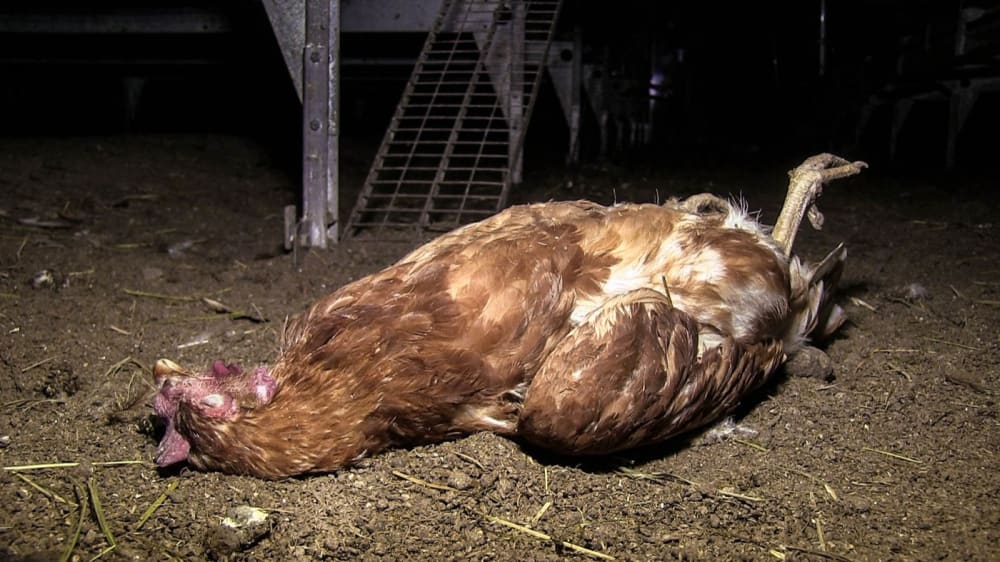

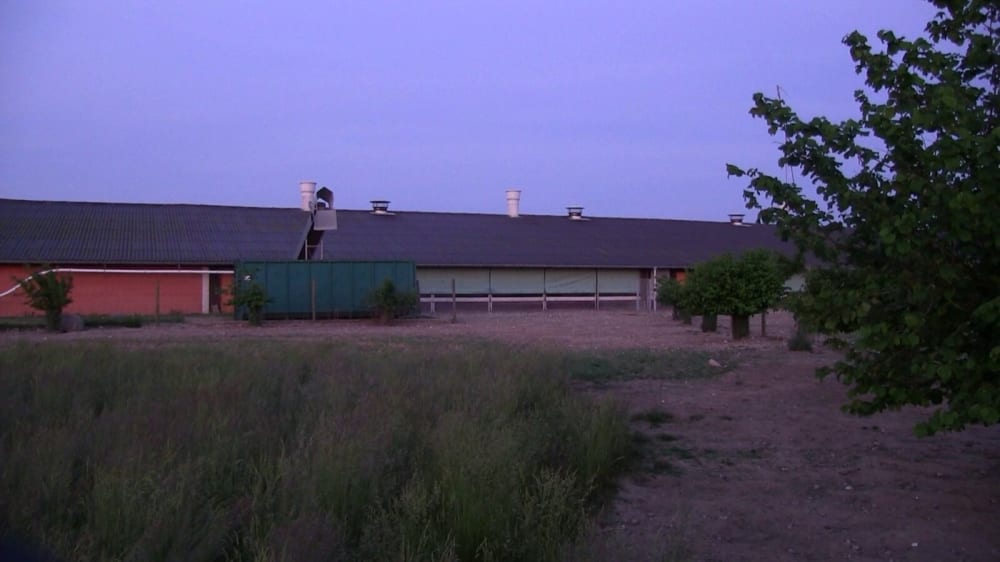
Deutsche Frühstücksei Bio farm, Wittstock/Dosse (2023)
- Who
- ARIWA with rbb Super.Markt, filmed July 2023. ARIWA says the group has "rund 16 Millionen Hühnern in 20 Betrieben".
- Found
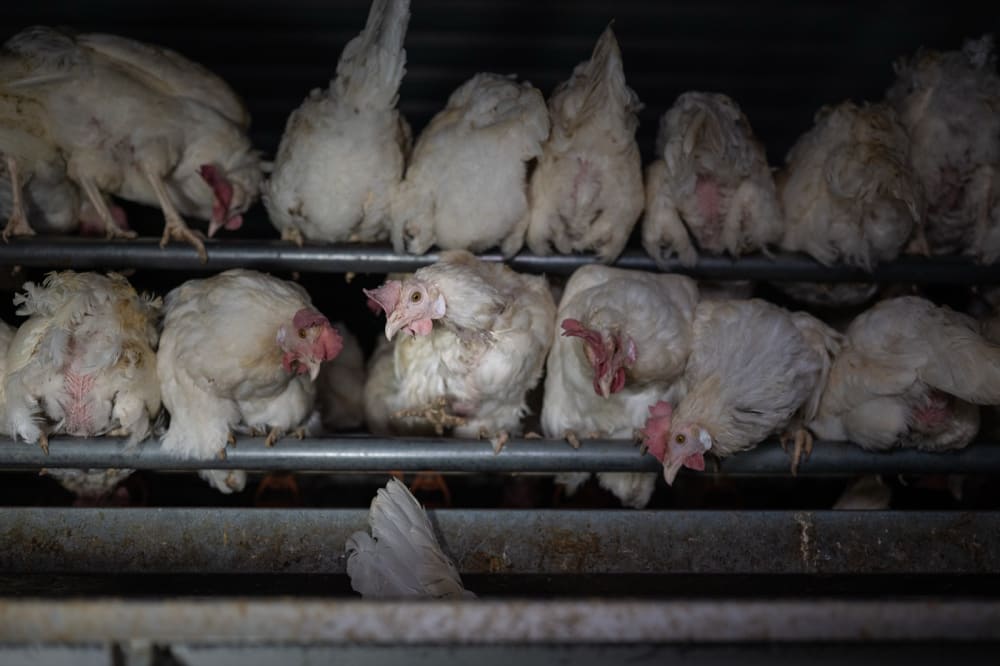
- hens with bald bellies, backs and necks, purulent cloacas, dead hens.
- Response
- Alnatura told Utopia its eggs have no connection to the farm. Brandenburg's animal welfare officer (rbb): an organic seal is no guarantee of welfare.
- Sources
- ARIWA release, Utopia

Official findings and court cases on Bio and Freiland eggs
- Oldenburg, 2011 to 2013
- Staatsanwaltschaft Oldenburg: barns held "1 bis 50 Prozent mehr Hühner ... als erlaubt", across all housing types incl. Bio and Freiland. About 150 Lower Saxony producers, "fast jeder fünfte Eierproduzent des Landes", plus about 50 in other states; the ministry said mostly conventional, some organic; investigations also against Naturland farms. 7 penalty orders issued by April 2013. (taz, taz, LZ)
- Meckl.-Vorpommern, 2013
- State authority LALLF: "vier Stalleinheiten mit insgesamt 12.000 Bio-Legehennenplätzen in drei Unternehmen" lacked the 4 m² range per hen; immediate ban on selling their eggs as organic; four prosecutions opened. The ministry made 16 unannounced checks after a tip. (Landtag Drucksache 6/2052)
- Wiesengold, 2012
- ARD FAKT and PETA footage at Bio-Geflügelhof Tiemann (Wiesengold Landei, Twistringen, then Germany's largest organic egg marketer, Naturland): hens almost without feathers, red mites, run unreachable for most hens. Naturland terminated the farm and had a different control body check "sämtliche rund 30 Betriebe" linked to the owner. (taz, Frontal 21)
- Fürstenhof, 2012/2018
- ARIWA footage of Fürstenhof barns (Biopark-labelled eggs) broadcast by MDR; the company sued. The Bundesgerichtshof ruled for MDR on 10 April 2018 (VI ZR 396/16): public interest in mass production of organic food outweighed the trespass. (LTO)
- Biopark, 2016
- taz reporters found the ranges of Biopark farms (Fürstenhof, Petznick, Mittenwalde) "überwiegend frei von Pflanzen", with "mitunter 30.000 Hühner in einem Gebäude". Biopark imposed no sanctions. A Green MP named Rewe, Edeka, Alnatura and denn's as buyers. (taz)
- Bioland, 2017
- ARIWA filmed three Bioland farms, including "Legehennen mit komplett nackten Hinterteilen" (farms not named). Bioland asked for the names. (biohandel) activist no photos saved.
Tests that looked at egg farms
- Warentest 2013
- Regional eggs with farm visits: four farms refused a visit; at Dachauer Land the inspector saw hens "nur im Stall und nicht im Freiland". Bioland eggs from Feneberg and Gut Schmerwitz credited with welfare beyond the law. (test.de)
- Öko-Test 2024
- 20 egg packs by questionnaire, no farm visits stated. Aldi's "Landfreude" free-range eggs "mangelhaft", because the supplier could not document the chain; Netto "Vom Land" free-range "ausreichend"; five Bio eggs "sehr gut", including Alnatura Bioland and K-Bio Bioland (Kaufland). (Utopia)
Chicken and turkey
- Warentest 2021
- Chicken legs incl. Bio: "In Deutschland besuchten wir 15 Mastbetriebe vor Ort". Bio providers Freiland Puten and Biofino rated best; Aldi Süd, Kaufland and Rewe sell Bio legs but "engagieren sich aber nur befriedigend", while their suppliers Biofino and Hubers Landhendl "haben die Mast gut im Griff". In three farms almost every third chicken had footpad lesions (farms not named). (test.de)
- Bio turkeys, 2013
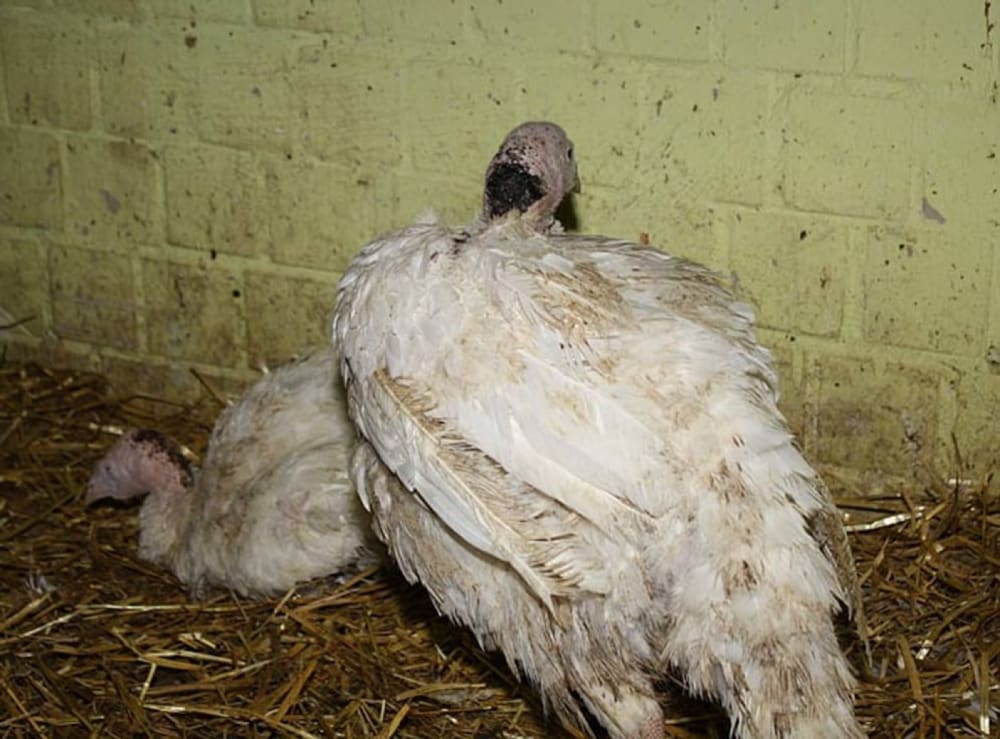
- activist ARIWA in four barns in Lower Saxony and Mecklenburg-Vorpommern (Weser-Kurier names farms in Sulingen-Barrien and Twistringen-Mörsen; no brand or association named): birds on "einer zentimeterdicken Schicht aus Kot und Stroh", injuries, dead birds in bins, unusually high mortality in documents. (t-online gallery)
- Bioland feed fraud, 2009
- NRW authority LANUV: Bioland poultry farm Franzsander (Delbrück) bought "mindestens 3.000 Tonnen" of conventional feed over three years. Organic status withdrawn, Bioland expelled him, prosecutors investigated. (taz)

Pigs and cattle
21 pig farms at Haltungsform 3 and 4 supplying Rewe and Edeka (2025)
- Who
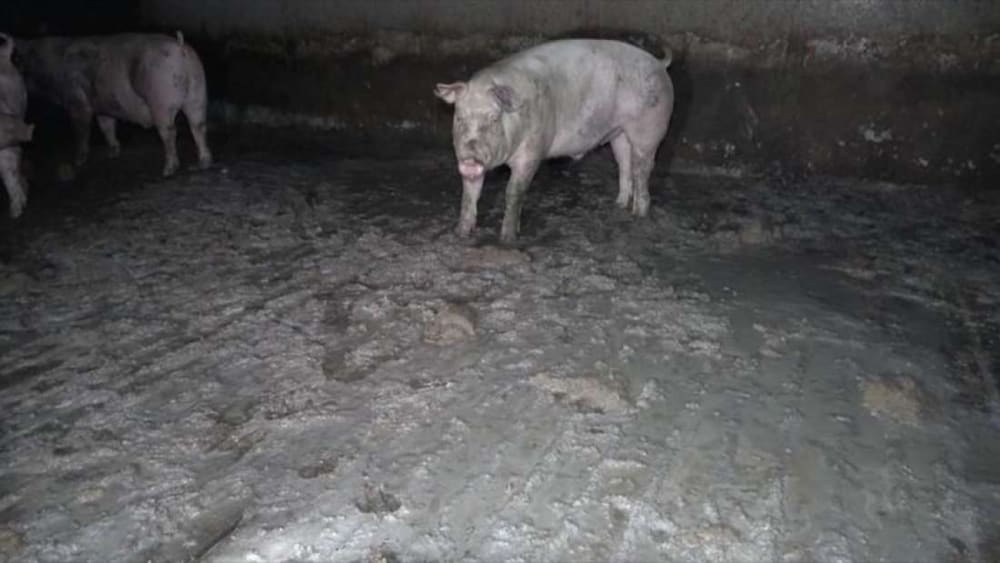
- ARIWA, with Spiegel and ZDF Frontal, May 2025: 21 pig farms in six states, Haltungsform 3 and 4 and other welfare labels, filmed over more than six months, described as supplying Rewe and Edeka. No specific retailer brand line named; the articles do not say which photo is from which level.
- Found
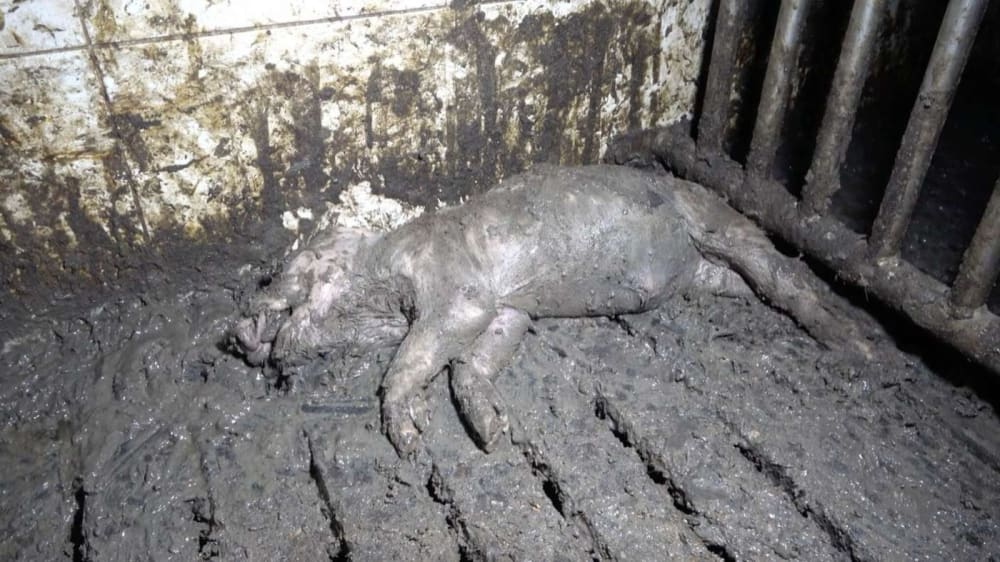
- injured untreated pigs lying on the floor, driving with blows, filthy pens, pigs standing in excrement, little or no straw, decomposing carcasses.
- Scale
- 21 farms filmed, criminal complaints against 12.
- Response
- Staatsanwaltschaft Oldenburg opened proceedings for the Osnabrück cases. Landkreis Osnabrück's unannounced April checks found "keine größeren Auffälligkeiten". No retailer statement found.
- Sulingen
- One of the farms, advertised as "Tierwohl-Haltungsstufe 4+" (Landkreis Diepholz), was already filmed by Spiegel TV and ARIWA in 2023 (carcass in a manure-covered pen, abscesses, slurry through the slats). The farmer denied it; prosecutors dropped the 2023 case and an expert found no violation in the video. The vet office in 2025 said the farm is closely monitored and showed no major problems weeks before.
- Sources
- leinetal24, ZDF Frontal, top agrar 2023, leinetal24 on Sulingen


- Bioland pigs, 2019
- activist ARIWA film at the Bioland farm Eichenhof, Lückau (Wendland; 300 sows, 2,500 fattening pigs): staff striking pigs with tools, one with a hammer, piglets carried by ears and tails, sows in farrowing crates. Bioland's surprise inspection and the vet office found no violation; the farmer's son called the hammer blow "absolutely unacceptable". (taz) No photos saved.
- Edeka Bio pork, 2015
- Staatsanwaltschaft Schwerin investigated a farmer in Ludwigslust-Parchim suspected of selling conventional pigs as organic, delivered via a processor to Edeka. (LZ)
- Warentest 2020
- Pork neck steaks, 15 products incl. 4 organic: only the two organic providers rated good on animal welfare; eight retail chains, from Aldi to Rewe, asked suppliers for hardly more than the law requires; Edeka gave no supplier information. (test.de)
- Organic dairy, 2021
- Nagold: a slaughterhouse vet flagged emaciated cows from an organic dairy farm; the inspection found many malnourished, sick cows. The court ordered a EUR 2,450 payment. (top agrar)
- EU audit, 2022
- The EU Commission found Germany may allow too many exceptions to the organic grazing duty. (top agrar)
Brands with no independent material found
Dairy: tests and investigations
Öko-Test, organic milk, February 2021
- Scope
- 20 organic whole milks, questionnaires to about 250 farms, sampled Aug to Sep 2020. Included organic lines of Aldi, Lidl, Rewe, Edeka, Kaufland, Netto and Penny.
- Found
- Only 4 providers proved that no milk came from tethered cows: Upländer Bauernmolkerei, Schwarzwaldmilch, Gläserne Molkerei and dennree. Only 8 proved pasture for every farm in the batch. "Einige Bio-Kühe stehen in ihrem ganzen Leben nicht ein einziges Mal auf einer Weide."
- Ratings
- Alnatura and dennree "sehr gut" overall. Weihenstephan refused to answer on animal welfare. The discounter lines rated only "befriedigend" on welfare transparency.
- Source
- oekotest.de
Öko-Test, organic natural yoghurt, July 2024
- Scope
- 20 organic natural yoghurts.
- Found
- "In elf Anbietern kommt die Milch sogar teilweise aus Bio-Betrieben, die Anbindehaltung praktizieren", meaning Kombihaltung on small farms. Pasture for all cows was confirmed for only about half the products.
- Ratings
- Only two "sehr gut": Netto BioBio Cremiger Bio Joghurt mild and Kaufland K-Bio Joghurt mild.
- Source
- Öko-Test press release
Öko-Test, Parmesan, September 2019
- Found
- Of about 70 dairy farms behind the tested Parmigiano and Grana, only one let its cows onto pasture. Six producers gave no or vague answers.
- Ratings
- Alnatura Parmigiano Reggiano was the only "gut"; Aldi Süd Cucina "befriedigend"; Giovanni Ferrari "ungenügend".
- Source
- t-online on Öko-Test
Other cases
- Öko-Test 2018
- Quark: the four "gut" products were all organic (Alnatura, Andechser, dennree, Söbbeke). (Utopia)
- Warentest 2023
- 28 fresh whole milks; five of the six best were organic. Tested taste and fatty acids, not farms. (test.de)
- Nagold 2021
- A slaughterhouse vet flagged emaciated cows from an organic dairy farm; the inspection found many malnourished, sick cows; the court ordered a EUR 2,450 payment. (in the brands report)
- EU audit 2022
- The Commission found Germany may allow too many exceptions to the organic grazing duty. (brands report)
- Calves
- dpa 2021: about 75% of calves from organic dairy cows go mostly into conventional fattening. (brands report)
I found no undercover recording or official finding at a farm supplying a named supermarket Bio or HF4 dairy line. That means nothing was found, not that the farms were checked and found fine.
Details per species
How to read the Haltungsform label





Label tabs as published on haltungsform.de (Initiative Tierwohl GmbH, Bonn).
Haltungsform is not a farm standard of its own. It is a retailer scheme run by the Initiative Tierwohl GmbH that sorts existing programmes (QS, Initiative Tierwohl, Neuland, Tierschutzbund, Bio associations and others) into five levels: 1 Stall, 2 Stall+Platz, 3 Frischluftstall, 4 Auslauf/Weide, 5 Bio. Roughly: 1 is the legal minimum, 2 is a bit more space and enrichment (Initiative Tierwohl level), 3 means contact with outdoor air but not necessarily going outside, 4 means the animals can go outdoors, 5 means certified organic. The five-level version replaced the older four levels (Stallhaltung, StallhaltungPlus, Außenklima, Premium) from summer 2024, and old packaging was used up gradually, so both versions can still turn up. It covers pig, chicken, turkey, Peking duck, rabbit, beef cattle (young bulls, oxen, heifers, veal calves) and dairy cows. It does not cover shell eggs, lamb or goat. For pigs it rates only the fattening phase, not the sows and piglets.
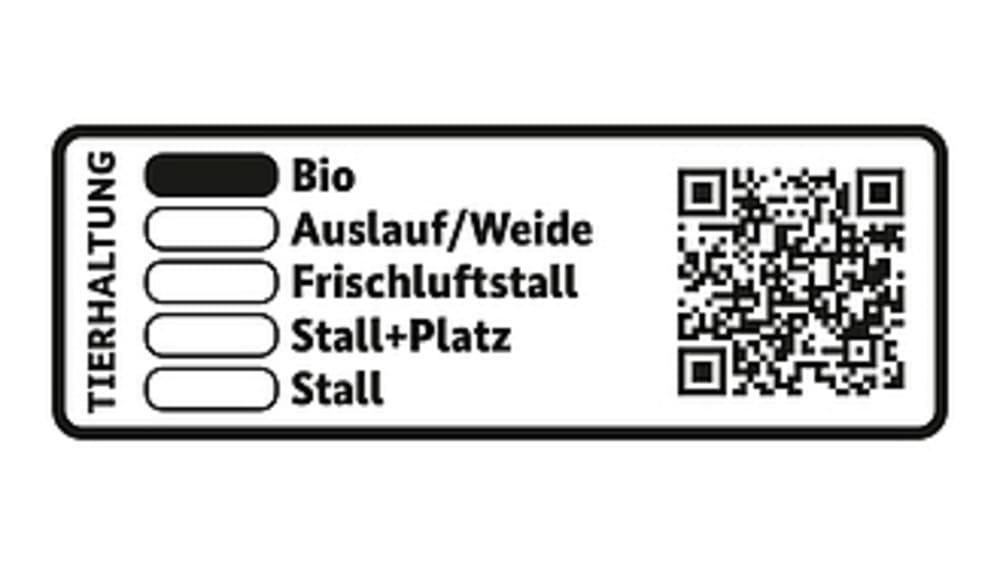
The state label (Tierhaltungskennzeichnung, law of 2023) uses the same five names and, as drawn by the BZL, looks like a black and white box with the levels stacked and a QR code. It is for fresh German pork only. The Bundestag pushed the mandatory start to 1 January 2027 (decided 15 January 2026), and on 16 October 2026 agrarheute reported that the CDU/CSU and SPD coalition had agreed to postpone it again, to 1 October 2027. That was a coalition agreement, not yet a passed law, when it was reported.
Chicken (Masthähnchen), with turkey
Minimum requirements per level, from the Haltungsform criteria tables (PDF, file dated 24 Feb 2025). kg/m² means kilograms of live bird per square metre of barn floor.
| Level | Space | Outdoors | Enrichment | Breed and feed |
|---|---|---|---|---|
| 1 Stall | max 39 kg/m² | none, closed barn | dry litter for pecking, scratching, dust bathing | robust lines (any growth rate); QS-approved feed; QS programme |
| 2 Stall+Platz | max 35 kg/m² | none, closed barn | plus material such as straw or pecking stones, at least 1 object per started 150 m² | as level 1; Initiative Tierwohl or equivalent |
| 3 Frischluftstall | max 25 kg/m², or 29 kg/m² with a Kaltscharraum (covered outdoor-climate area) | permanent access to an outdoor-climate area (Wintergarten), not to open land | at least 2 objects per started 150 m², or per 2,000 birds 3 straw or hay bales plus 1 pecking object per 1,000 | slow-growing breed, max 45 g weight gain per day (51 g/day with gait-score checks); GMO-free feed |
| 4 Auslauf/Weide | max 21 kg/m² | access to open land for at least 1/3 of life; area mostly vegetated, with shelter structures | extra litter (straw, wood shavings, sand or peat) on at least 1/3 of the floor | slow-growing, max 45 g/day; GMO-free; at least 20% of feed from own farm or region |
| 5 Bio | max 21 kg/m² | open land whenever weather allows, at least 1/3 of life; at least 4 m² per bird (fixed barn) or 2.5 m² (mobile barn) | litter on at least 1/3 of the floor | slow-growing (max 45 g/day) or fast-growing if slaughtered at 81 days or older; organic, GMO-free feed, at least 30% from own farm or region; EU organic certified |
For scale: a 2 kg broiler at 39 kg/m² is about 19 to 20 birds per square metre; at 21 kg/m² it is about 10 to 11. These two figures are my arithmetic from the kg limits, not numbers from the criteria table.



Turkey (Pute), for comparison
| Level | Space | Outdoors | Breed |
|---|---|---|---|
| 1 | max 58 kg/m² toms, 52 kg/m² hens | none | robust lines |
| 2 | max 53 / 48 kg/m² (at least 10% more space) | none | robust lines |
| 3 | max 41 / 37 kg/m² (at least 30% more) | permanent access to an outdoor-climate area | slow-growing, max 110 g/day, or fast-growing slaughtered at 140 days or older (toms) / 100 days (hens) |
| 4 | max 21 kg/m² (at least 60% more) | open land for at least 1/3 of life | same rule as level 3 |
| 5 | max 21 kg/m², max 2,500 turkeys per barn | open land at least 1/3 of life when weather allows, at least 10 m² per bird | same rule as level 3 |
No turkey photos: I found none from the sources I was using that show a specific level.
Pig (Mastschwein)
Space is usable floor per animal by weight class. Level 1 matches the legal minimum. Haltungsform rates only the fattening phase: its FAQ says piglet castration and tail docking are not criteria.
| Level | Space per pig | Outdoors | Enrichment | Feed and other |
|---|---|---|---|---|
| 1 Stall | 30 to 50 kg: 0.5 m² 50 to 110 kg: 0.75 m² over 110 kg: 1.0 m² | none, closed barn | organic, high-fibre material to root in | QS-approved feed; QS programme |
| 2 Stall+Platz | 0.563 / 0.844 / 1.125 m² (12.5% more) | none | pen divided by at least 3 structural elements; plus roughage | QS feed; Initiative Tierwohl or equivalent |
| 3 Frischluftstall | open-front barn: 30 to 50 kg 0.7 m², 50 to 120 kg 1.3 m², over 120 kg 1.5 m² barn with run: 0.7 / 1.1 / 1.4 m² | outdoor climate: an open-front barn, or a barn with permanent access to a run | plus straw (as bedding or roughage) or similar | GMO-free or regional feed for the whole fattening period |
| 4 Auslauf/Weide | 30 to 50 kg 0.75 m² (0.25 m² of it outside) 50 to 120 kg 1.5 m² (0.5 m² outside) over 120 kg 2.3 m² (0.8 m² outside) | permanent access to a run, or kept outdoors (Freiland) | straw or similar | GMO-free; at least 20% feed from own farm or region |
| 5 Bio | up to 110 kg: 1.3 m² inside plus 1 m² run over 110 kg: 1.5 m² inside plus 1.2 m² run | permanent access to a run, or outdoors | straw or similar; rooting material in the run | organic, GMO-free feed, at least 30% from own farm or region |


Cattle (beef and dairy)
Beef cattle (Jungbullen, Ochsen, Färsen, Mastkälber)
Conditions must apply for at least the last 6 months before slaughter.
| Level | Space per animal (loose housing) | Housing and outdoors | Dehorning | Feed |
|---|---|---|---|---|
| 1 Stall | to 150 kg 1.5 m², to 220 kg 1.7 m², to 400 kg 1.8 m², over 400 kg 2.2 m² | barn, preferably loose; tethering allowed | under 6 weeks, by farmer, with pain relief | QS-approved |
| 2 Stall+Platz | 1.5 / 1.8 / 2.5 / 3 m² | loose housing; oxen and heifers may be in combined housing with grazing (at least 120 days, 2 h) or an exercise area of 4.5 m²; no tethering for bulls | as level 1 | QS-approved |
| 3 Frischluftstall | 1.5 / 2 / 3 / 4 m² | loose housing with year-round yard (at least 3 m² each), or grazing at least 120 days of 6 h, or open-front barn; no tethering | as level 1 | GMO-free, at least the last 6 months |
| 4 Auslauf/Weide | to 100 kg 1.5 m², to 200 kg 2.5 m², to 400 kg 4 m², over 400 kg 5 m² (min 1 m² per 100 kg) | permanent access to a yard (at least 3 m²) or pasture; no tethering | only in exceptional cases, by vet under anaesthesia | GMO-free; at least 60% from own farm or region; at least 60% of dry matter as roughage |
| 5 Bio | to 100 kg 1.5 m², to 200 kg 2.5 m², to 350 kg 4 m², over 350 kg 5 m² (min 1 m² per 100 kg) | loose housing with yard or pasture; no tethering (EU organic law allows seasonal tethering in some cases) | only in exceptional cases | organic, GMO-free; at least 70% from own farm or region; at least 60% roughage |
Dairy cows (this is the level printed on milk)
| Level | Space | Housing and outdoors | Other |
|---|---|---|---|
| 1 Stall | cubicle barn: one cubicle per cow | barn; "preferably" loose or combined housing, so tethering is still possible | QS feed |
| 2 Stall+Platz | one cubicle per cow, or 4 m² per cow without cubicles | loose housing, or combined housing with grazing (at least 120 days, 2 h) or an exercise area | scratching brush |
| 3 Frischluftstall | or 5 m² per cow without cubicles | loose housing with year-round yard (3 m² each), or open-front barn, or grazing at least 120 days of 6 h; no tethering | GMO-free feed |
| 4 Auslauf/Weide | or 6 m², or 1,000 m² of pasture per cow | loose housing with yard and grazing at least 120 days of 6 h; no tethering | GMO-free; 60% feed from own farm or region; 60% roughage |
| 5 Bio | or 6 m² | loose housing and grazing whenever conditions allow; no tethering (seasonal tethering allowed by EU organic law in some cases) | organic, GMO-free; 70% own farm or region; 60% roughage |



Also covered by Haltungsform but left out here: Peking duck (max 20 kg/m² at levels 1 to 4, or 25 kg/m² at level 3 with permanent outdoor access; open water for swimming from level 4) and rabbit. Both are in the same criteria PDF.
Eggs: the printed code, not Haltungsform
Haltungsform does not cover shell eggs (they are not in its list of species). Eggs carry the EU producer code stamped on the shell: first digit = housing, then country, then farm number, for example 0-DE-1344461. Germany banned the last cages (Kleingruppenhaltung) from 1 January 2026; § 45 of the Tierschutz-Nutztierhaltungsverordnung lets authorities extend this to 31 December 2028 in hardship cases. The KAT association lets you trace the code online, but only for KAT member farms.
| Code | System | Space inside | Outdoors | Other |
|---|---|---|---|---|
| 0 | Bio (Ökohaltung) | max 6 hens per m² usable area (about 0.17 m² each) | at least 4 m² per hen | max 3,000 hens per compartment; at least 18 cm perch per hen; organic feed |
| 1 | Freiland | as Bodenhaltung (about 0.11 m² each) | at least 4 m² per hen | |
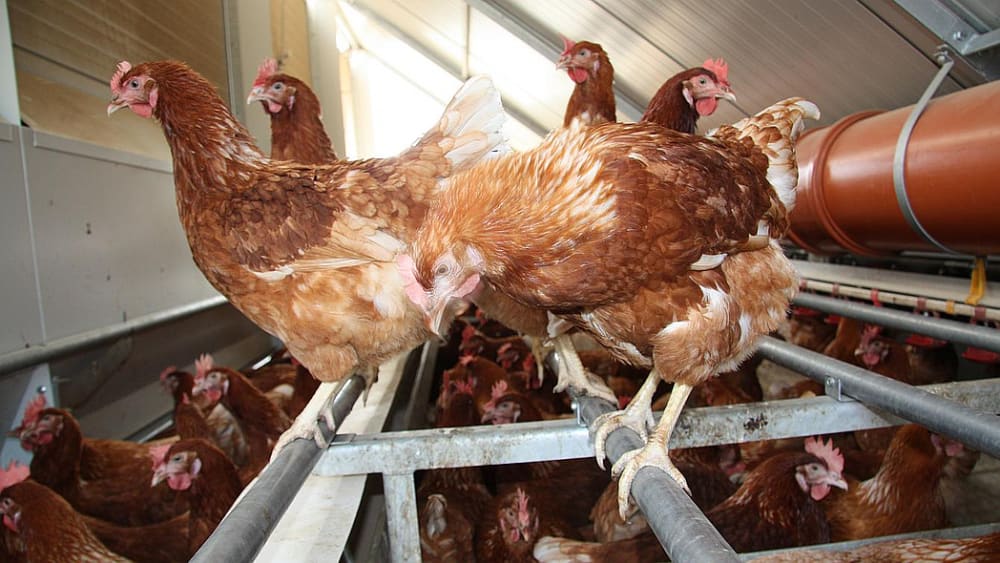
| 2 | Bodenhaltung (barn) | max 9 hens per m² usable area; in multi-tier aviaries max 18 hens per m² of barn floor | none | max 6,000 hens without separation; litter on at least 1/3 of floor, min 250 cm² per hen |
| 3 | Käfig / Kleingruppe | about 0.08 m² per hen | none | banned in Germany since 1 Jan 2026 (hardship extensions possible to end 2028) |
Share of German laying hens in 2024 (BZL / Destatis): Bodenhaltung 57.7%, Freiland 23.6%, Öko 14.3%, Kleingruppe 4.3%. Eggs in pasta, cakes and other processed food, and cooked or dyed eggs, need no housing statement; the Verbraucherzentrale notes such eggs can still come from imported cage systems.




Lamb and goat
Neither Haltungsform nor the state label covers sheep or goats. Haltungsform's FAQ says it started with "the most market-relevant species" and is working on others; the state label so far applies only to fresh German pork. So there is no level 1 to 5 for lamb or goat, and none should be read into the packaging.
What you can rely on is the organic label (EU organic leaf, or Bioland, Naturland, Demeter). EU organic rules require access to pasture whenever conditions allow, and set minimum space:
| EU organic minimum | Inside, per head | Outside, per head |
|---|---|---|
| Sheep or goat | 1.5 m² | 2.5 m² |
| Lamb or kid | 0.35 m² | 0.5 m² |
Without an organic label, nothing on a lamb or goat pack tells you how the animal was kept.

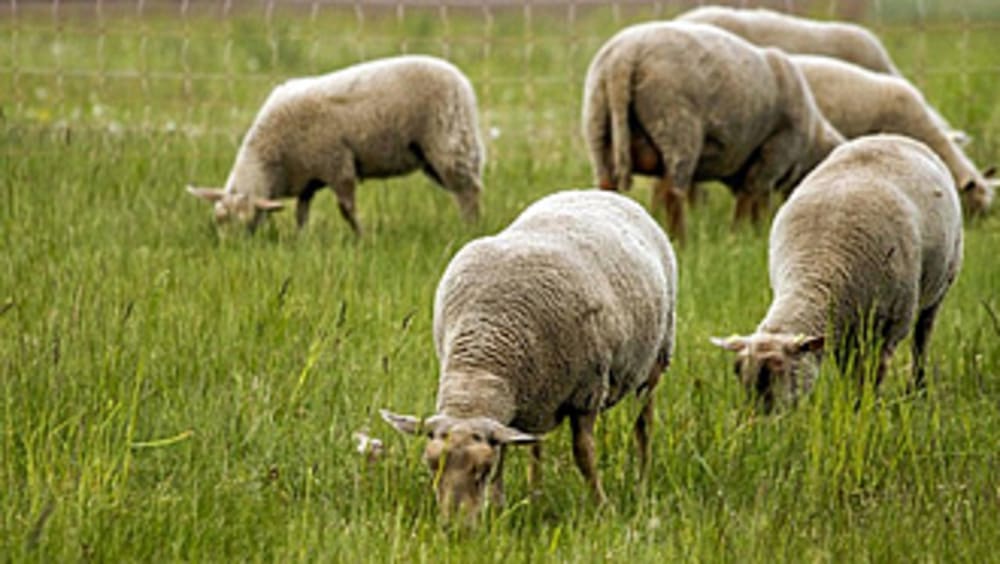

Dairy: which products carry a Haltungsform level
Milk got Haltungsform in January 2022, alongside meat. The retailers in Initiative Tierwohl agreed that "Milch und Milchprodukte wie Käse und Joghurt" could carry the label. Drinking milk came first, and other dairy has followed product by product, so far mostly for German milk. The dairy-cow criteria per level are in the first report and are not repeated here. In short: 1 allows year-round tethering, 2 allows seasonal tethering (Kombihaltung) with grazing or an exercise area, 3 is the first level without tethering, 4 adds grazing for at least 120 days of 6 hours, and 5 is Bio.
| Product | Carries a level today? | What the retailers have said |
|---|---|---|
| Drinking milk | yes, at all the big chains | Aldi Nord and Süd: own-brand drinking milk only HF3 to 5 since spring 2024 (Aldi Süd: since February 2024). Lidl and Edeka: 100% of own-brand drinking milk HF3 or higher (top agrar, 25 Jul 2025). Rewe: about 90% of its fresh milk HF3. Kaufland 2023: over 60% of own-brand fresh milk and over 40% of UHT milk at HF3/4. |
| Yoghurt, quark, cream | partly | Lidl: quark, fresh cream, Schmand, körniger Frischkäse and Skyr Pur to HF3+ by end of 2025, "ausschließlich Produkte aus deutscher Landwirtschaft" (Lebensmittel Praxis, 17 Jul 2025). Edeka: all natural quark HF3+ from early 2026; yoghurt, mozzarella, mascarpone and cream to follow. |
| Cheese | some German cheese only | Edeka: 50% of own-brand sliced, grated and block cheese on HF3+ milk (Jul 2025). Lidl: "Ausgenommen bleiben zunächst Butter und Käse" (Jul 2025). I found no retailer statement that Aldi, Rewe or Kaufland print a level on cheese today. |
| Imported cheese | usually no | Parmigiano, Gouda, Comté, feta and the like are made from foreign milk; the retailers' HF switches above are stated for German milk. On imported cheese, only the Bio logo tells you anything about how the cows were kept. |
"Weidemilch" on its own is not a legal term (Verbraucherzentrale NRW: "weder definiert noch geschützt"). The Pro Weideland label behind much Weidemilch requires 120 days of 6 hours on pasture, 2,000 m² of grassland per cow (at least 1,000 m² as pasture) and no tethering; the Verbraucherzentrale says such farms usually land at HF3 or 4. Stiftung Warentest (Feb 2023, 28 milks) found that Weidemilch without a Bio seal had "kaum mehr günstige Fettsäuren als konventionelle Milch", while Bio and Heumilch had the most.
Dairy: what each label allows on tethering
Two things are called tethering. Anbindehaltung means the cow is chained or strapped by the neck in a stall all year. Kombihaltung (Kombinationshaltung) means tied in the barn in winter, with pasture in summer and some outdoor access in winter. Thünen-Institut (2020 census): 11% of German dairy cows were tethered, 8% year-round. No German law bans either yet. Region Hannover issued its own order on 7 July 2026 banning year-round tethering within 18 months and seasonal forms within 3 to 7 years, citing § 2 Tierschutzgesetz. That order applies only to Region Hannover.
So the only labels that rule out both forms on paper are Haltungsform 3 and 4 (conventional), Biopark, and Biokreis for newer farms. Every other Bio label, including Bioland, Naturland and Demeter, can contain milk from small farms that tie cows in winter. That is what the Öko-Test cases below keep finding.
The tethering picture per label is in the label ladder.
Full wording per label
| Label | Year-round tethering | Seasonal tethering (Kombihaltung) | Pasture |
|---|---|---|---|
| Haltungsform 1 | allowed | allowed | not required |
| Haltungsform 2 | no | allowed, with grazing (120 days, 2 h) or an exercise area | not required |
| Haltungsform 3 | no | no | one of: year-round yard, open-front barn, or grazing 120 days of 6 h |
| Haltungsform 4 | no | no | yard and grazing 120 days of 6 h |
| EU-Bio (= HF5 minimum) | no; individual animals only, temporarily | allowed on farms of up to 50 animals: pasture in the grazing season, outdoor access at least twice a week otherwise | whenever conditions allow |
| Bioland | "ausgeschlossen" | small herds only, with approval of the control body; no new tie-stall barns; rigid neck frames, tight chains and cow trainers banned | mandatory; farms existing on 1 Dec 2018 may use a year-round yard instead until 31 Dec 2030 |
| Gäa | "ausgeschlossen" | existing small herds only, with approval; same wording as Bioland | as Bioland |
| Naturland | "nicht zulässig" | only in small herds, max 35 livestock units (annual average) in Öko-Kombinationshaltung; pasture in season, outdoors at least twice a week otherwise; cow trainers banned | Laufstall "möglichst mit Weidegang"; pasture in season for Kombihaltung |
| Demeter | no explicit clause found in the 2026 rules | still practised: Demeter's own animal-welfare inspection guide names farms "in denen noch Kombihaltung (Anbindehaltung im Winter + Sommerweidehaltung) praktiziert wird" and wants their unannounced check in winter | mandatory in the growing season, at least 600 m² per livestock unit (yard-only farms existing at end of 2021 may get until 2030) |
| Biokreis | "ausgeschlossen" | allowed only on small member farms that joined before 1 March 2024, with approval; banned for newer members | in the growing season |
| Biopark | "nicht gestattet" | "Die Anbindehaltung von Wiederkäuern ist nicht gestattet" (no exception for small farms found) | at least the summer half-year |
Cheese: what the label cannot tell you
Imported cheese. No German level, and no Haltungsform switch was announced for foreign milk. A Bio logo is the only housing information on Gouda, Parmigiano or feta. Bio farms abroad follow EU-Bio, which allows Kombihaltung on farms of up to 50 animals.
Rennet. Cheese may be sold without listing the rennet type, so you cannot tell animal rennet from microbial rennet on most packs (Öko-Test). Bio shops usually state it.
PDO cheese. Parmigiano Reggiano's production rules require "l'uso esclusivo di caglio di vitello", so it is never vegetarian (disciplinare). A PDO seal protects origin and recipe and says nothing about tethering or pasture, as the 2019 Öko-Test showed.
Pitfalls
- Code 0 or "Bio" alone is the EU minimum. An egg from an EU-minimum organic farm and one from a Demeter farm both carry 0. Only the association logo on the pack tells them apart.
- Flock size matters more than the label suggests. EU-Bio caps a compartment at 3,000 hens but not the building; Bio units of 15,000 in 3,000-hen sections were "üblich" (Thünen, 2013). The average organic egg farm with over 3,000 places has about 10,500 hens. In a 2003 Lower Saxony organic study, 9.8% of a 4,500-hen flock were out in the run against 40% of a 1,450-hen flock (hen rows in the ladder). Most of the 9.8% stayed within 17 m of the barn. No current national figure was found.
- Processed food with eggs says nothing. Pasta, cakes, cooked or dyed eggs need no housing statement and can come from imported cage systems.
- Old packs use the old 4-level label. Before summer 2024 the levels were Stallhaltung, StallhaltungPlus, Außenklima, Premium, and Bio was "4 Premium". A "4" on an old pack is Bio; old and new packs can still both turn up.
- Haltungsform for pork covers only fattening. Sows, piglets, tail docking and castration are outside it. Only association rules cover those.
- Bio milk can still come from tethered cows. EU-Bio allows seasonal tethering on farms of up to 50 animals; Öko-Test found only 4 of 20 organic milks proved otherwise (2021), and 11 of 20 organic yoghurt providers partly used such farms (2024).
- Imported cheese has no level at all. Only a Bio logo says anything. A PDO seal protects origin and recipe, not the cows. Rennet type need not be labelled; Parmigiano Reggiano uses calf rennet only.
- "Weidemilch" is not a legal term. Some pack levels on this page come from Open Food Facts, a crowd-sourced database of pack photos, not from the retailer; they are marked.
- Lamb and goat have no level. Without an organic logo, nothing on the pack tells you how the animal was kept.
- The cases are individual, not a sample. Most are activist recordings, usually made by entering barns at night; farms and authorities dispute several. Most concern Bio eggs because that is where most investigations were done. A brand with no cases was not shown to be clean.
Claude's recommendation
Ranked by the written rules behind each line and how much of a weekly shop it covers, using only the facts on this page. This is not a ranking of proven farm practice: for the top pick, no independent checks were found at all, and that means nobody's findings are on record, not that the farms passed.
Lidl, Bioland line
One association across meat, eggs and milk (about 100 products), with German organic eggs from rooster rearing since 2021. Bioland bans beak trimming and tail docking, caps hens at 6,000 per building and 140 per hectare, and requires pasture for cattle. The simplest store for "association logo on everything".
no independent checks found for this line.
Kaufland, K-Bio (Bioland or Demeter)
Bioland meat (17 items such as mince and goulash) and over 150 Bioland items including milk; Demeter is in the line too, and Demeter has the strictest rules on the page (3,000 hens per building, 16 kg/m² broilers, no dehorning). Check the logo on each pack, and pass on K-Wertschätze, which is only level 3.
the K-Bio Bioland eggs' "sehr gut" came from a questionnaire, not a farm visit, and Bio egg farms said to supply Kaufland were filmed in 2019 and 2023 (neither case names K-Bio).
Rewe, REWE Bio (Naturland)
All REWE Bio meat is Naturland, the eggs are code 0 with brother roosters, and Bioland milk has been there since January 2026. The widest Bio meat range among the full-range chains on the page.
Naturland allows the largest hen buildings of the four (12,000), only about 60% of the egg farms are Naturland, and Naturland-certified egg farms were filmed in 2021 (not linked to Rewe on the source page). Rewe's own 2025 cases are about HF3 and 4 pigs and Freiland eggs, not REWE Bio.
Sources
What this page cannot tell you. Which species each Bio line covers is mostly not itemised (e.g. "all REWE Bio meat", Penny's 750 products), so the meat tile means "some meat is listed". No Edeka egg line, no Alnatura meat line and nothing beyond milk at Aldi Nord was found; cheese and yoghurt associations at Rewe, Kaufland and Edeka are not confirmed. No Demeter own-brand dairy was found at any retailer. There is no data here on prices, on which branches stock a line, or on top-level turkey and duck lines. No independent checks were found for Demeter, Gäa, Lidl's Bioland line, Penny Naturgut, Netto BioBio, Aldi Nord Gut Bio, Rewe Premium Landbauern, Edeka Natur Pur and Hofglück, any HF4 chicken or turkey line, any named supermarket Bio or HF4 dairy line, any sheep or goat farm, or any Bornheim shop.
Levels and criteria
- Haltungsform, criteria tables for all species: haltungsform.de PDF (file dated 24 Feb 2025; pages stamped March 2024 and November 2024). Overview and species list: haltungsform.de; FAQ.
- Switch from 4 to 5 levels in summer 2024, old level names, coverage: Verbraucherzentrale.
- State label, postponement to 1 Jan 2027: Deutscher Bundestag, 15 Jan 2026. Coalition agreement on 1 Oct 2027: agrarheute, 16 Oct 2026. Levels and scope: BZL; top agrar, 20 Nov 2023.
- Eggs, barn rules: § 13a TierSchNutztV; cage phase-out: § 45 TierSchNutztV; ban, KAT, processed eggs: Verbraucherzentrale Niedersachsen; space per hen and shares: BZL infographics (linked under the images).
- EU organic rules: Regulation (EU) 2018/848, Annex II (pasture access, 3,000 hens per compartment, 81-day rule), and Implementing Regulation (EU) 2020/464, Annex I (space for sheep, goats, hens, broilers); read via the text copies at legislation.gov.uk (2018/848) and legislation.gov.uk (2020/464) because EUR-Lex blocked automated access.
- Retailers: Aldi Süd; Lebensmittel Praxis, 21 Oct 2025.
- Photos: credited under each image. Photos from landwirtschaft.de and oekolandbau.de belong to the named photographers, BLE or the stock agencies; each credit links to the original.
Brands, rules and checks
- EU law: Reg. (EU) 2018/848 Annex II and Art. 33, legislation.gov.uk copy; Impl. Reg. (EU) 2020/464 Annex I, legislation.gov.uk copy (these copies show the text as of end-2020; EUR-Lex blocked automated access); Del. Reg. (EU) 2023/2465, EU Publications Office; egg codes, Directive 2002/4/EC, annex; § 13a TierSchNutztV.
- Associations: Bioland Richtlinien, March 2026; Naturland Richtlinien Erzeugung 05/2026; Demeter Gesamt-Richtlinie 2026; Gäa Richtlinien, March 2026; Biopark Erzeugerrichtlinie, January 2022.
- Real practice: BLE egg report 2025; Thünen Steckbrief Legehennen 2018; Elbe et al., organic hens in large flocks; Bazer, LMU 2005; ISN factsheet Feb 2025; Thünen on tethering; Öko-Test milk 2021; Öko-Test yoghurt 2024; dpa on organic calves; foodwatch 2023; Bavarian organic control 2024; Initiative Tierwohl audits 2017.
- Retailers: Rewe Bio, Rewe eggs, Rewe programmes; Bioland at Rewe; Edeka Bioland; Edeka Nord Natur Pur; Hofglück; Edeka/Netto eggs; Netto BioBio; Aldi and Naturland; Aldi Süd levels; Aldi Süd farm traceability; Lidl Bioland; Kaufland Bioland; Penny Naturgut; Alnatura Origin; denn's/biomarkt.de; Rossmann and Bioland.
- Cases: linked in each case above.
- Photos: every still is the publishing organisation's own image, credited under it. The one marketing photo is Aldi Süd's own.
Dairy and Bornheim shops
- Haltungsform on dairy: Lebensmittel Praxis, Jan 2022; top agrar, 2 Jul 2021; top agrar, 25 Jul 2025 (Edeka, Lidl); Lebensmittel Praxis, 17 Jul 2025 (Lidl); top agrar (Edeka cheese); Lebensmittel Praxis (Aldi milk); Aldi Süd; top agrar (Rewe 90%); Lebensmittel Praxis, 2023 (Kaufland).
- Weidemilch: Verbraucherzentrale NRW; Stiftung Warentest, 22 Feb 2023.
- Tethering rules: Bioland Richtlinien March 2026, 6.1.1 and 6.2.1.1 to 6.2.1.3 (PDF); Gäa Richtlinien March 2026; Naturland Richtlinien Erzeugung 05/2026, B.II cattle, footnotes 32 and 33; Demeter Gesamt-Richtlinie 2026, 3.2.1, and Demeter's Leitfaden für Tierwohlkontrollen; Biokreis Richtlinien Erzeugung, April 2026, 8.1.2.4; Biopark Erzeugerrichtlinie, January 2022; BÖLW, 25 Apr 2024; Region Hannover, 7 Jul 2026; Thünen census figures and EU-Bio rule via the brands report.
- Retailer lines: Bioland at Rewe; Edeka Bioland; Edeka 2022, no year-round tethering; Aldi Süd Nur Nur Natur 2026; Lidl Bioland; Kaufland Bioland; Netto Naturland; Alnatura Weidemilch, Feb 2024; Lebensmittel Zeitung, Aug 2026 (dennree); Hofgut Eichigt; Open Food Facts: REWE Bio Weidemilch, K-Bio Vollmilch, Naturgut Weidemilch.
- Tests: linked in each case above. Cheese: Öko-Test on rennet; Parmigiano Reggiano disciplinare.
- Shops: HFM market list; VisitFrankfurt; Erzeugermarkt Konstablerwache; Kleinmarkthalle, Hoos; reviewhero, Hoos; Gref-Völsing; Wikipedia; denn's Berger Str. 155; denn's Friedberger Landstr.; kennstdueinen (Alnatura Burgstraße); Feinkost NOY; MainÄppelHaus; OpenStreetMap for the Käseladen am Merianplatz, Josef's Bio, Metzgerei Völp, tegut and the hours marked OSM.
- Photos: credited under each image.
Photos added on this page
Farm and advertising photos from Aldi Süd, Rewe, Alnatura and BioMarkt (denn's) pages, and practice photos from landwirtschaft.de (BZL/BLE) are credited under each image in Life in photos; retailer photos are credited under each image. Pack photos and logos are credited where they appear.